Sound Equalization, oder kurz EQ, bedeutet, dass der Tontechniker die Signalpegel bestimmter Frequenzen hebt (Gain up) oder absenkt (Gain down).
Die meisten Geräusche, die wir hören, sind komplex und enthalten Audiosignale auf vielen verschiedenen Frequenzen.
Da zur Anpassung der Frequenzpegel spezielle Werkzeuge benötigt werden, wurde das EQ (Equalizer) entwickelt.
Das menschliche Ohr kann normalerweise Töne von 20 Hz bis 20 kHz hören.
Mit zunehmendem Alter lässt das Hörvermögen nach, und dieser Frequenzbereich verringert sich ebenfalls.
EQ kann verwendet werden, um die Aufnahme eines Instruments oder eines Voice-Overs zu verbessern.
Es kann jedoch schlechte Aufnahmen nicht – und sollte nicht – beheben.
Ist die Aufnahme nicht zufriedenstellend, überprüft der Tontechniker zuerst die Mikrofonposition oder probiert ein anderes Mikrofon mit anderen Klangeigenschaften.
Im Allgemeinen schneidet ein guter Techniker beim Einsatz von EQ Signale eher oder nimmt Pegel weg, statt sie zu verstärken.
Eine Aufnahme klingt natürlicher, wenn unerwünschte Anteile reduziert statt gewünschte Frequenzen angehoben werden.
Der Grund ist, dass beim Anheben einzelner Frequenzen mit EQ das Werkzeug praktisch wie ein Vorverstärker arbeitet.
Da EQ nicht als Vorverstärker konzipiert ist, führen Anhebungen zu unerwünschten und unnatürlichen Artefakten in der Aufnahme.
Das menschliche Gehör ist am empfindlichsten für mittlere und obere Mittenfrequenzen. Aufgrund dieser Empfindlichkeit können große Anhebungen in diesem Bereich ein Projekt hart oder schrill klingen lassen.
Equalization-Tools können Hardware-basiert sein, aber inzwischen werden immer häufiger softwarebasierte EQ-Anwendungen als Plug-ins oder Add-ons für Aufnahmeplattformen genutzt.
Equalizer-Typen
Die beiden häufigsten Varianten sind grafische und parametrische Equalizer.
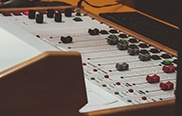
Ein grafischer Equalizer besteht aus Schiebereglern, mit denen verschiedene Frequenzbereiche angehoben oder abgesenkt werden.
Anzahl und Breite der Filter hängen vom Einsatzbereich ab
Ein parametrischer Equalizer besteht aus Drehreglern, mit denen sich Verstärkung, Bandbreite und Mittenfrequenz einstellen lassen.
Einige EQ-Tools haben keine Kontrolle über die Bandbreite, da diese fest eingestellt ist.
Diese werden als quasi-parametrische oder semi-parametrische Equalizer bezeichnet.
Gängige EQ-Voreinstellungen
Low-Shelf-Filter
Ein Low-Shelf-Filter funktioniert wie ein Bassregler an einer Stereoanlage. Low-Shelf-Filter passen das Signalniveau an der eingestellten Frequenz und allen darunter liegenden Frequenzen an.
High-Shelf-Filter
Ein High-Shelf-Filter funktioniert wie ein Höhenregler an einer Stereoanlage. High-Shelf-Filter passen den Pegel des Signals bei der eingestellten Frequenz und allen höheren Frequenzen an.
Verstärkung
Die Verstärkung regelt den Pegel des Signals bei der eingestellten Frequenz und einigen umliegenden Frequenzen. Die Q-Einstellung legt fest, wie viele benachbarte Frequenzen betroffen sind.
Q
Der Q-Faktor, auch Resonanz oder Bandbreite genannt, regelt die Zahl der umliegenden Frequenzen, die beeinflusst werden. Die Breite des Q wird meist in Oktaven angegeben.
Das Anheben der Harmonischen eines Instruments sorgt laut vielen Technikern für mehr Präsenz, Klarheit oder Brillanz.
Die tiefen Frequenzen werden für Punch oder Präsenz verwendet, die hohen Frequenzen betonen Klarheit oder Brillanz.
Bei Voice Crafters beginnen wir normalerweise mit einer voreingestellten EQ-Vorlage für Voiceovers und passen die Einstellungen je nach Stimmklang des Sprechers an.
Typischerweise verwendet man einen Low Cut (oder High-Pass, je nach Vorliebe) bei etwa 80–100 Hz für Männer und bis zu 120 Hz für Frauen, um die Unklarheit der Stimmen zu verringern.
Natürlich sind unsere Ohren die wichtigsten Werkzeuge beim Feintuning der gewünschten Frequenzen..
Die richtigen Frequenzen so einzustellen, dass eine Sprachaufnahme lebendig klingt, erfordert jahrelange Erfahrung und Know-how.
Daher ist es wichtig, bei der Auswahl des Studios und der Techniker für Ihr Projekt wählerisch zu sein.




0 Kommentare